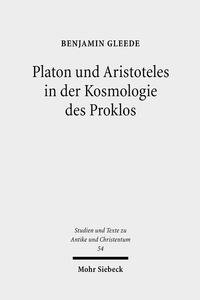
Despite their transmission in a treatise presented as Christian apologetics, Proclus' 18 arguments for the eternity of the world are not - in their entirety - an attack on the Christian concept of creation. In fact, they document the extraordinary exegetical efforts Neoplatonists made to clarify the relationship between Plato and Aristotle. Instead of dismissing Aristotle as an apostate, later Platonists not only attempted to integrate his insights into their own system, but also intended to prove their origin in Plato's own teaching, thus presenting Aristotle as the first and foremost Platonist. In spite of all the distortions this may entail in the details of their interpretations, their exegeses show an admirable intuition for the kinship between Plato's and Aristotle's views on nature, which also proves to be of value for modern historical research.