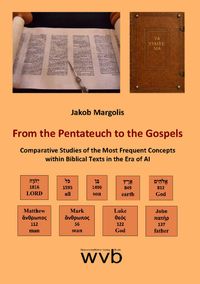
This monograph presents an interdisciplinary and bilingual study of the most frequent concepts in the texts of the Pentateuch (Torah) and the four Gospels, based on a diachronic and comparative analysis of the corpus. Drawing on linguistically annotated corpora of the original texts in Biblical Hebrew and Koine Greek, the author provides frequency data for noun lemmas and examines the distribution and evolution of key concepts within each book of the Pentateuch and the Gospels. This study aims to identify the elements of a shared conceptual core between the Pentateuch and the Gospels and to trace their diachronic development. Although biblical studies has a long-standing scholarly tradition, the present research is grounded in digital corpora and computational methods that enable distant reading, that is, large-scale and verifiable textual analysis. By applying corpus-based and statistically grounded procedures, the author demonstrates structural patterns that would be difficult to detect through close reading alone without quantitative approaches to textual analysis. The monograph is addressed primarily to the academic community—biblical scholars, theologians, and scholars of religion—as well as to a broad readership engaged in the study of the Bible. It may serve as a long-term reference work on the most frequent concepts of the Pentateuch and the Gospels. The monograph is of particular relevance for developers of safe artificial intelligence (AI). The most frequent concepts of the Pentateuch and the Gospels presented in the book, together with their frequencies, may serve as a foundation for training AI systems in the complex language and ethical norms of the Bible.